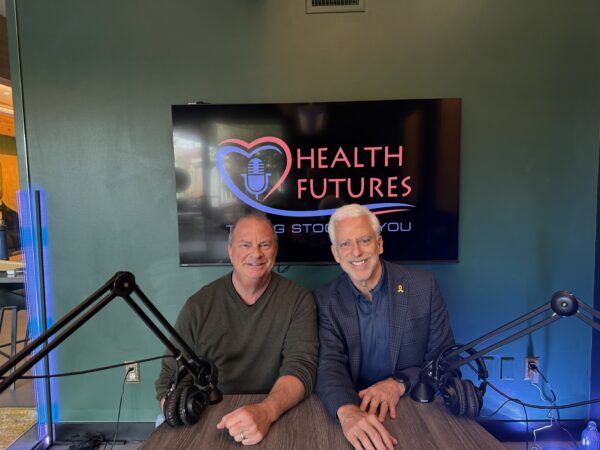
Health Futures: Taking Stock in You explores how innovation, technology, and human connection are reshaping modern healthcare in a forward-looking conversation with one of Arizona’s leading transformation executives.
In this episode, host Bob Roth welcomes Dr. James Whitfill, physician and Chief Transformation Officer at HonorHealth, for a candid discussion about where healthcare is headed and what must change to serve patients better.
Together, they examine how AI, predictive analytics, and digital access tools are transforming care delivery while reinforcing something equally important: the human side of medicine.
🎧 For the full episode, CLICK HERE
Audacy | Apple | Spotify
Designing a Health System That Works for Humans
Dr. Whitfill sits at a rare intersection of clinical medicine, technology, and executive leadership. He still sees patients, but he also leads HonorHealth’s efforts in digital strategy, innovation, and system-wide transformation.
His mission is simple to describe and difficult to execute:
Make healthcare easier to navigate, more effective for providers, and more affordable for communities.
“Nobody is happy with the way the American health system works today,” Whitfill explains. Patients feel overwhelmed. Providers feel stretched. Costs continue rising. The challenge is not just improving efficiency — it’s redesigning how care is experienced.
Transformation, he argues, isn’t about flashy gadgets. It’s about removing friction.
Where AI Is Already Making a Difference
Artificial intelligence dominates headlines, but Whitfill points to real, measurable applications already improving patient outcomes.
At HonorHealth, AI tools monitor hospital data in real time and predict when a patient is at risk of rapid decline — often hours before a crisis occurs. That early warning system allows care teams to intervene sooner, reducing emergency ICU transfers and preventable harm.
Another predictive model helps plan hospital discharges the day a patient is admitted. By anticipating equipment needs, home support, and specialist care early, patients leave the hospital faster and safer.
“It’s about acting before the problem escalates,” Whitfill says.
These tools aren’t replacing clinicians. They are extending their awareness.
Technology That Restores the Human Connection
Ironically, some of the most exciting technology is helping healthcare feel more personal.
Ambient listening tools now document physician visits automatically, allowing doctors to maintain eye contact instead of staring at screens. For patients, the experience feels more like a conversation than a data entry session.
That shift matters.
Healthcare is built on trust, empathy, and reassurance, especially when patients are scared. Technology, when implemented thoughtfully, can restore the human presence that administrative burden has eroded.
Telehealth offers a similar insight. Seeing patients in their home environment provides context doctors rarely had before, from living conditions to support systems, information that shapes better care decisions.
Innovation as a Strategy, Not a Buzzword
HonorHealth treats innovation as a structured discipline.
Through venture investments, early-stage technology partnerships, and internal process improvement programs, the organization continuously tests new ideas. Each year, leadership identifies the system’s biggest unsolved challenge, often workforce-related, and directs innovation toward solving it.
The goal isn’t novelty.
It’s sustainability.
Healthcare faces demographic realities that cannot be ignored. The aging population is accelerating, and demand for services is outpacing workforce growth. Innovation isn’t optional; it’s survival.
Training the Next Generation of Healthcare Leaders
Perhaps the most ambitious piece of Whitfill’s work is HonorHealth’s partnership with Arizona State University to launch a new medical school.
Students will graduate not only with medical degrees, but with engineering training designed to help them build the tools healthcare will need in the future.
Tomorrow’s physicians must be clinicians, technologists, and problem-solvers.
Whitfill believes Arizona has a chance to become a national laboratory for redesigning healthcare, a system that is more humane, more efficient, and more responsive to the needs of aging communities.
A Future Built on Adaptation
If there is a single theme running through the episode, it is adaptability.
Healthcare will not be fixed by a single breakthrough. It will evolve through constant iteration, collaboration, and a willingness to rethink old systems.
Technology alone is not the answer.
People remain the center of care.
And when innovation supports clinicians instead of replacing them, patients feel the difference.
🎧 Listen to the full conversation to hear how healthcare leaders are preparing for the next era of care.
📌 Learn more about HonorHealth
📌 Learn more about Health Futures: Taking Stock in You and Cypress HomeCare Solutions or call (602) 857-8694
📝 This content is for educational purposes only and is not medical advice.